Rokid's AR Glasses Will Pack a Custom 6nm Chip and a Qualcomm Coprocessor
Hengxuan Technology confirmed Tuesday that Rokid’s upcoming AR glasses will run on its BES2810 chip. The 6nm processor integrates an NPU and a HiFi 5s audio core, designed for low-power operation and a new voice interaction system with customizable sound fields.
The glasses also carry a Qualcomm Snapdragon spatial computing coprocessor fabricated on a 3nm node — the first AR device to use this chipset. Rokid says the combined horsepower exceeds the Rokid AR Studio, Meta Quest Pro, and Pico 4.
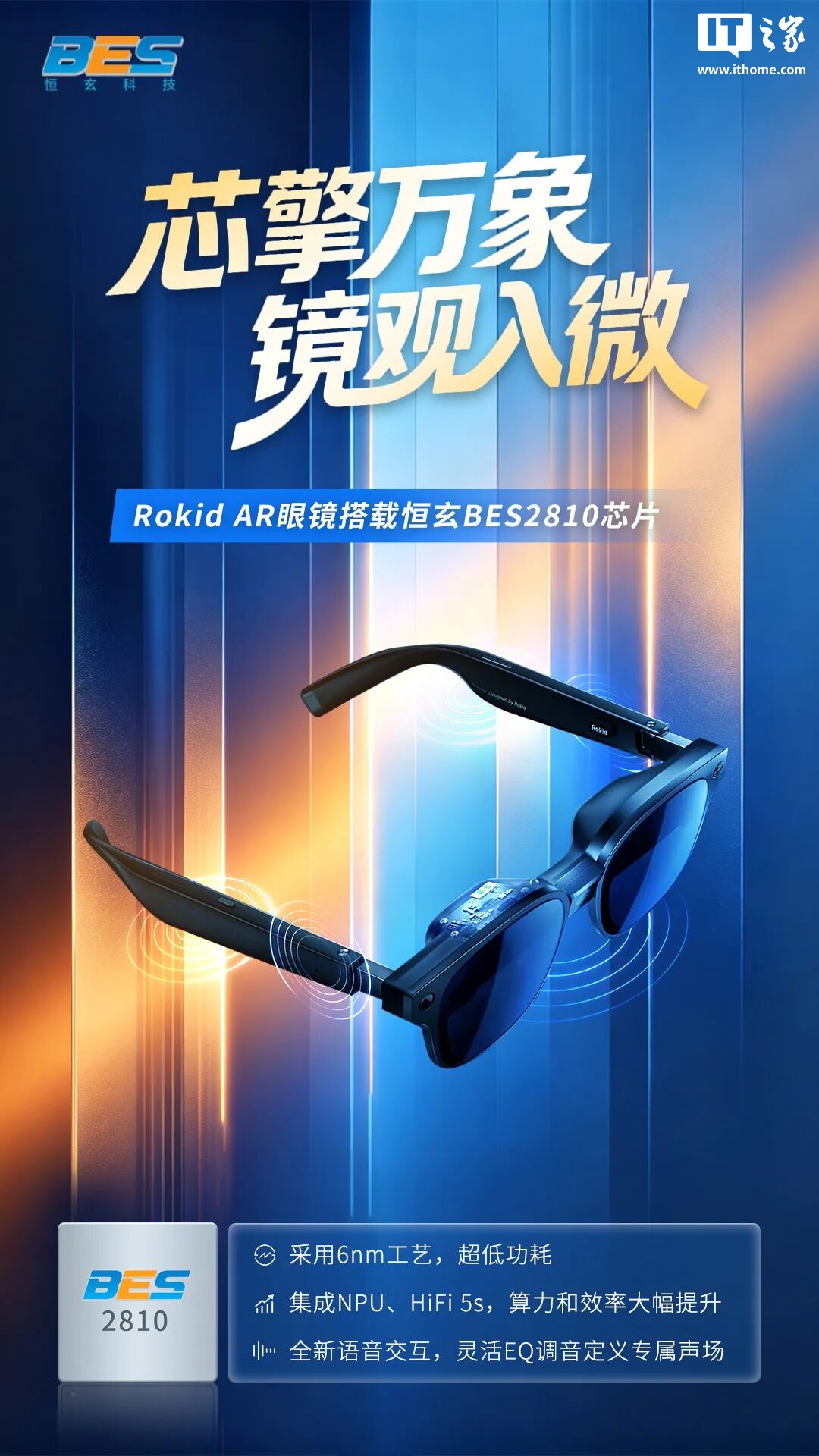
The product first appeared at Rokid Open Day 2026 on June 26. It packs a dual-camera system for spatial sensing and AI, electrochromic lenses, 6DoF tracking, and a 58-degree field of view.

Hengxuan Technology, better known by its BES brand, has spent years making chips for wireless earbuds and hearables. The BES2810 is its first foray into wearable AR, and the 6nm process points squarely at battery life — the make-or-break metric for all-day glasses.
No price or release date yet.
Market Context
Rokid’s decision to custom-design the audio and AI processing chip rather than relying on a single off-the-shelf SoC signals growing maturity in the AR market. The dual-chip architecture—a dedicated audio/NPU chip from Hengxuan paired with a Qualcomm spatial computing processor—mirrors the approach taken by premium smartphones, where separate ISP and application processors handle specialized workloads.
The 6nm BES2810’s focus on low-power voice interaction is strategic: AR glasses that drain their battery in under two hours have limited mainstream appeal. By offloading always-on voice and sensor processing to the power-efficient Hengxuan chip, the Qualcomm coprocessor can focus on rendering spatial content only when needed.
Competitors including Meta’s Quest lineup and Apple’s Vision Pro have focused on all-in-one compute, but Rokid’s modular chip strategy could yield thinner, lighter frames with longer run times—a decisive factor for all-day wearables. The electrochromic lenses and 58-degree FOV put it in the same class as Xreal’s latest Air series, though Rokid’s dual-camera spatial sensing setup suggests it may support hand tracking and environmental mapping out of the box.